United States · 9 min
How to Specify Custom Blister Packaging for Electronics
A useful electronics packaging specification connects product geometry, distribution risks, presentation goals, materials and quality requirements so suppliers can quote accurately.
TRAYVORA Packaging Team · Updated July 2026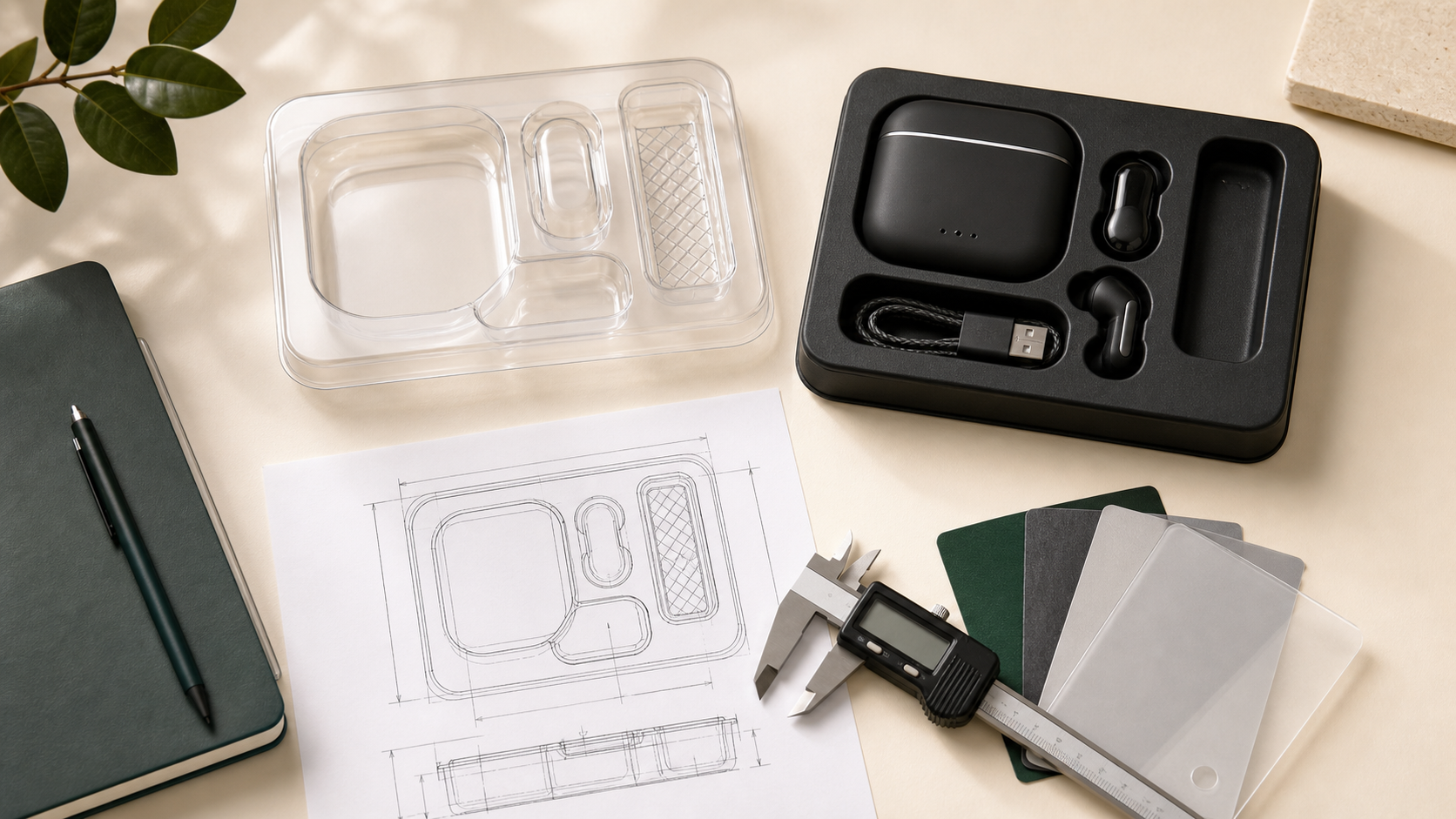
01
Start with the product and its route to market
The best custom blister packaging projects start with the product, not the plastic. A retail Bluetooth headset has different needs from a tray moving circuit boards between production stations. Define where the package is filled, how it ships, whether it appears on a shelf and what happens after opening.
Share accurate dimensions, weight, orientation and no-contact areas. Mark buttons, polished surfaces, antennas, connectors, cables and removable accessories. This lets the tray designer place support points where they protect the product without pressing on sensitive features.
- Product dimensions, weight and revision
- 2D drawings, CAD files or representative samples
- Required orientation and presentation angle
- Accessories packed in the same tray
- Packing, storage, shipping and retail conditions
02
Define protection before choosing a cavity shape
An attractive cavity is not automatically protective. State what the packaging must prevent: movement, scratches, component contact, accidental button activation, cable tangling or damage from stacking. This gives the supplier a basis for adding ribs, finger access, retention and clearance.
If electrostatic discharge is a concern, do not assume every black or tinted plastic provides ESD protection. Specify measurable electrical behavior and a verification method. Distribution tests should use the complete pack, because an empty tray cannot represent the product, accessories, carton and cushioning system.
- Maximum acceptable movement
- Non-contact cosmetic surfaces
- Drop, vibration or compression requirements
- ESD control, if applicable
- Acceptable condition on arrival
03
Choose the correct packaging architecture
Blister packaging can mean several structures. A clear blister sealed to card supports retail visibility. A clamshell integrates a lid and hinge. A thermoformed insert organizes the product inside a carton, while a lidded tray may suit reusable handling. Name the intended format so quotations are comparable.
For retail electronics, balance visibility with printable space and the opening experience. For industrial electronics, loading speed, stable stacking and part protection may matter more than shelf presentation.
04
Specify performance, not just a resin name
PET, recycled-content PET, PVC, PP and other sheets behave differently in forming, sealing, handling and recovery systems. Ask for a recommendation based on clarity, stiffness, impact behavior, sealing method, temperature exposure, local expectations and cost—not a generic best material.
Incoming sheet gauge is not the finished wall thickness. Thermoforming stretches material, especially at deep corners. Identify critical performance areas and let the supplier propose a starting gauge and geometry that protect them.
- Transparency, tint and finish
- Stiffness and impact needs
- Sealing compatibility
- Temperature and humidity exposure
- Recycled-content objectives
- Critical minimum-thickness locations
05
Control fit, access and manufacturability
A tray must hold the product while remaining easy to load and open. Tight snaps can mark a housing or slow the line; loose cavities allow movement and noise. Review the tolerance of both the electronics and the formed part, then validate with production-intent products.
Finger recesses, draft angles, radii and draw depth affect access, forming consistency and tool release. For automated packing, share datum locations, pick points, equipment limits and acceptable flange variation before tooling begins.
06
Make quotes and approvals comparable
Give every supplier the same annual demand, order pattern, destination and packing assumptions. Request separate design, tooling and unit pricing, plus price breaks if demand is uncertain. Ask each supplier to list assumptions and exclusions.
Before production, approve the drawing, material, fit method, critical dimensions, cosmetic criteria, packing, labeling and change-control process. A golden sample helps, but it should support—not replace—a controlled specification.
COMMON QUESTIONS
Practical answers.
What does a supplier need to design electronics blister packaging?+
Provide product dimensions, weight, files or samples, sensitive areas, orientation, accessories, protection goals, volume and the shipping or retail environment.
How tight should the tray hold the product?+
It should limit harmful movement without marking or deforming the product or making removal difficult. Validate fit across realistic product tolerances.
Does every electronics tray need ESD material?+
No. Base the requirement on device sensitivity and handling conditions, then specify measurable performance and verification.
Can recycled-content plastic be clear?+
Often, but clarity, supply consistency, forming performance and documentation depend on the proposed grade and should be sampled.